

Read time: 6 minutes
If you are thinking about going back to school, you have likely heard the same advice from friends, family, or coworkers: "Just go get your GED. It’s the same thing as a diploma, and it’s faster."
It sounds like a quick fix: take a test, get a certificate, move on. But this advice is often outdated and based on misconceptions. While the GED is valid, it differs from a high school diploma—especially for your future career, military enlistment, or college preparation.
At Smart Schools, we talk to people every day who are weighing these two options. To help you make the right choice for your future, let’s bust five common myths about the GED and explore why earning a real high school diploma through our program might be a better path.
Myth #1: "The Military Views the GED and Diploma Equally"
The Myth: Many people believe that if you want to join the Army, Navy, Air Force, or Marines, a GED is just as good as a diploma. They assume that as long as you pass the ASVAB test, you are in.
The Reality: This is perhaps the most impactful myth for anyone hoping to serve their country. The U.S. military categorizes recruits into two distinct tiers based on education:
Tier 1: High school diploma graduates.
Tier 2: GED holders.

According to CollegeVine, the military strictly limits Tier 2 (GED) recruits, often to less than 5%–10% annually. Tier 2 recruits also need much higher ASVAB scores to qualify. However, if a person with a GED completes 15 or more college credits, they can often be reclassified as Tier 1.
Why This Matters: If you have a GED, you are fighting for a very small number of spots. If you have a traditional high school diploma, you are a Tier 1 candidate, which opens the door to more enlistment opportunities and gives you access to more job roles and enlistment bonuses.
Benefit of Smart Schools: When you graduate from Smart Schools, you earn a high School Diploma. This makes you more desirable for military service, giving you an advantage over GED applicants.
Myth #2: "The GED is an 'Easier Way'"
It’s often seen as the "easy button" compared to completing high school credits. Many believe the GED is just a formality—a quick test to pass.
If you haven’t seen the GED since 2014, it may surprise you. The exam now requires advanced critical thinking, math, and reading skills. Many pay for months of study, only to fail a section and start over.
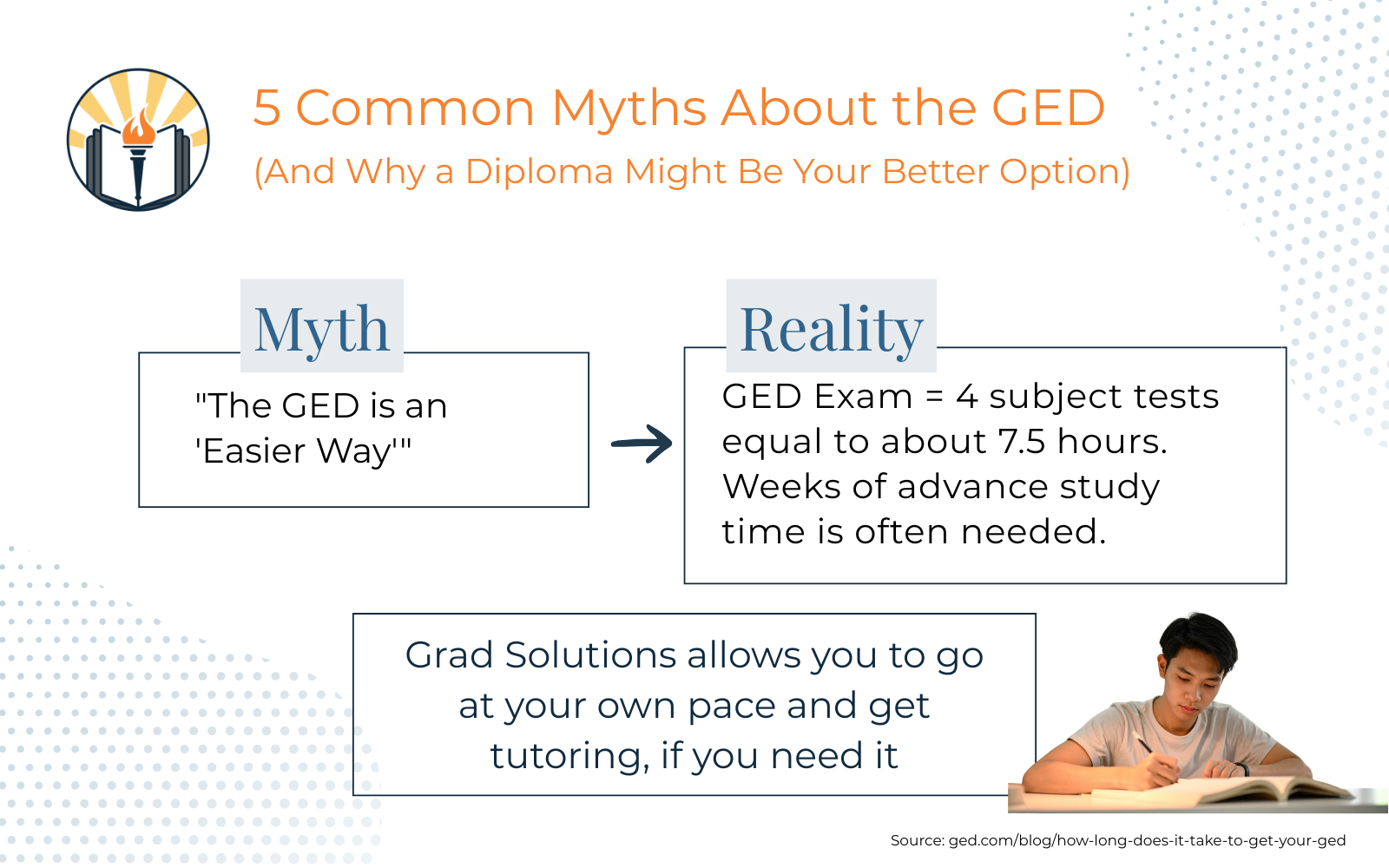
Why This Persists: Older generations remember the pre-2014 GED, which was significantly easier. Some may share this information, not realizing that the test has become more challenging to pass.
Benefit of Smart Schools: At Smart Schools, we don't force you to pass a single gargantuan test. We operate on a credit recovery model. You complete the specific courses you are missing at your own pace. If you struggle with math, you don't fail the whole program; you just get extra help with that one class. You take a manageable load of 1-2 courses at a time so you don’t feel overwhelmed.
Myth #3: "Employers Can’t Tell the Difference"
The Myth: The assumption is that "a credential is a credential." Most people think that once you check the box that says "High School Equivalent," the conversation is over.
A GED is a legal equivalency, but tells a different story on a resume. To some, a diploma shows persistence and completion of a long-term goal. A GED can suggest taking a shortcut (even if that’s not true for you).

For entry-level jobs, a GED or a diploma may not matter. But as competition grows, a diploma often gives a perceived edge in dedication and follow-through.
Myth #4: "You Can’t Go to College with a GED"
The Myth: On the flip side, some people think a GED disqualifies you from college entirely.
The Reality: You can get into college with a GED. However, the path is often bumpier. GED holders are statistically more likely to be placed in remedial courses—non-credit classes you have to pay for and don't count toward your degree. This happens because the GED test doesn't always prepare you for college-level coursework the way a structured curriculum does.
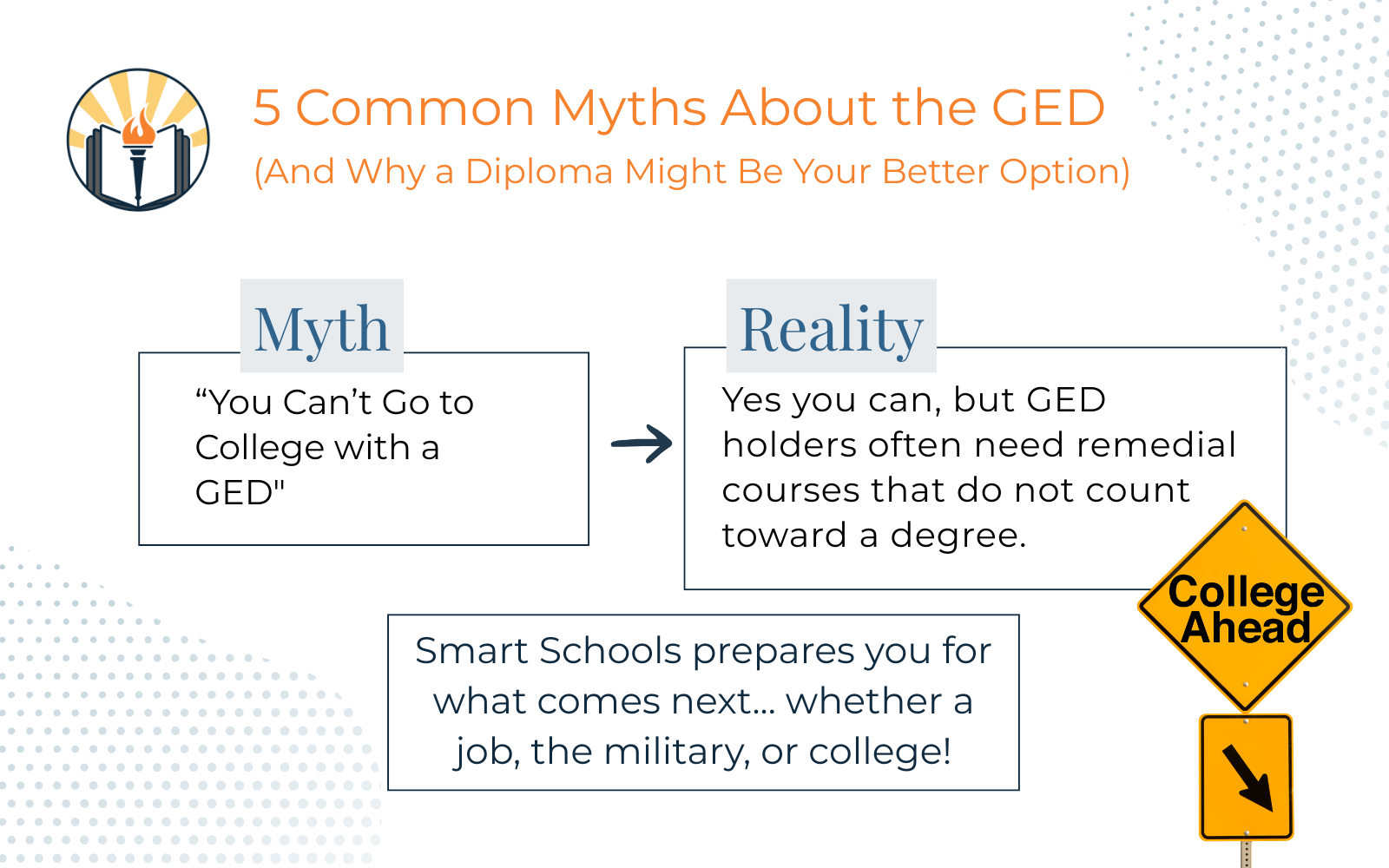
Benefit of Smart Schools: Our diploma program is designed not just to get you a piece of paper, but to prepare you for what comes next. By taking actual classes (like English 12 or Algebra), you are keeping your brain in "learning mode," making the transition to college or trade school much smoother.
Myth #5: "It’s Too Late for Me to Get a Real Diploma"
This is the most heartbreaking myth. Many drop out at 16 or 17 and think, "I'm too old for high school. The GED is my only option."
The Reality: In Arizona, you can enroll in dropout recovery programs up until the age of 21 (and sometimes older with the Arizona Workforce Development Program). Age is rarely the barrier people think it is.
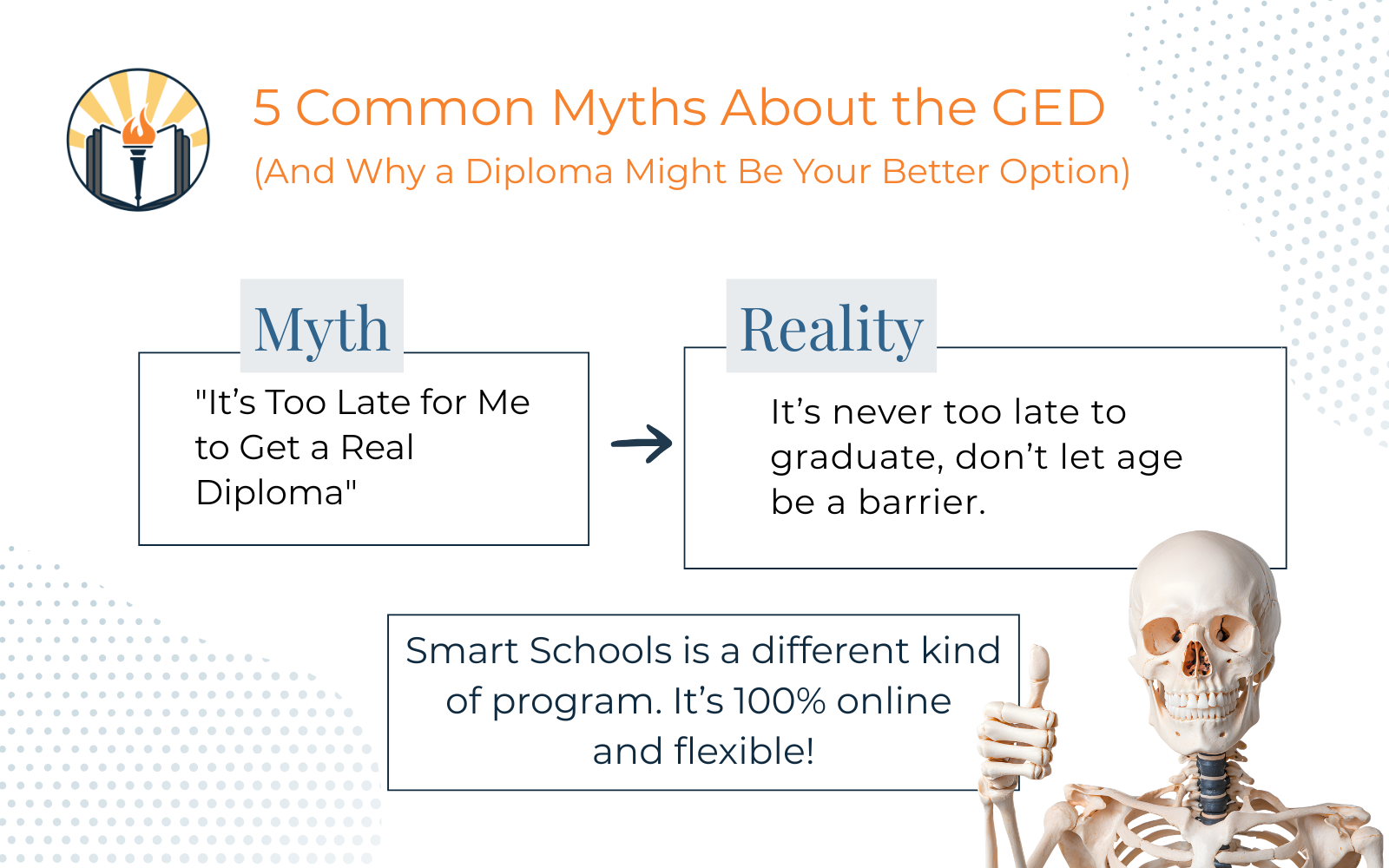
Why This Persists: People associate "high school" with sitting in a classroom with teenagers, raising their hand to go to the bathroom, and dealing with drama. They can't imagine returning to that environment.
This is why Smart Schools, and Smart Schools, exists. We aren’t a traditional classroom. Our online, self-paced program is designed for people who need something different. Study when it suits you—even late at night or while your kids nap. You earn a real diploma without the hassle of going back to school the traditional way.
The Bottom Line: You Don't Have to Settle
The GED is a valuable tool for some, but it is not your only option. If you want the military Tier 1 status, the pride of a true diploma, and a curriculum that actually prepares you for the workforce, you don't have to settle for an equivalency. Smart Schools can help you can earn a real high school diploma.
You did the hard work of deciding to finish your education. You deserve the credential that opens the most doors.
Ready to see if you qualify for a real high school diploma?
How to Get Started
Ready to earn your high school diploma? Find out how Smart Schools can help you accomplish your goal and learn more about our free tutoring, academic advising, and flexible learning options. You can achieve your dreams and build a brighter future with the proper support.
Additional Reading
Joining the Military With a GED: Requirements for Each Branch (Indeed)
GED Acceptance in Military Branches (CollegeVine)